
You Never Return the Same Way
Spring doesn't restore us. It reveals what has changed.

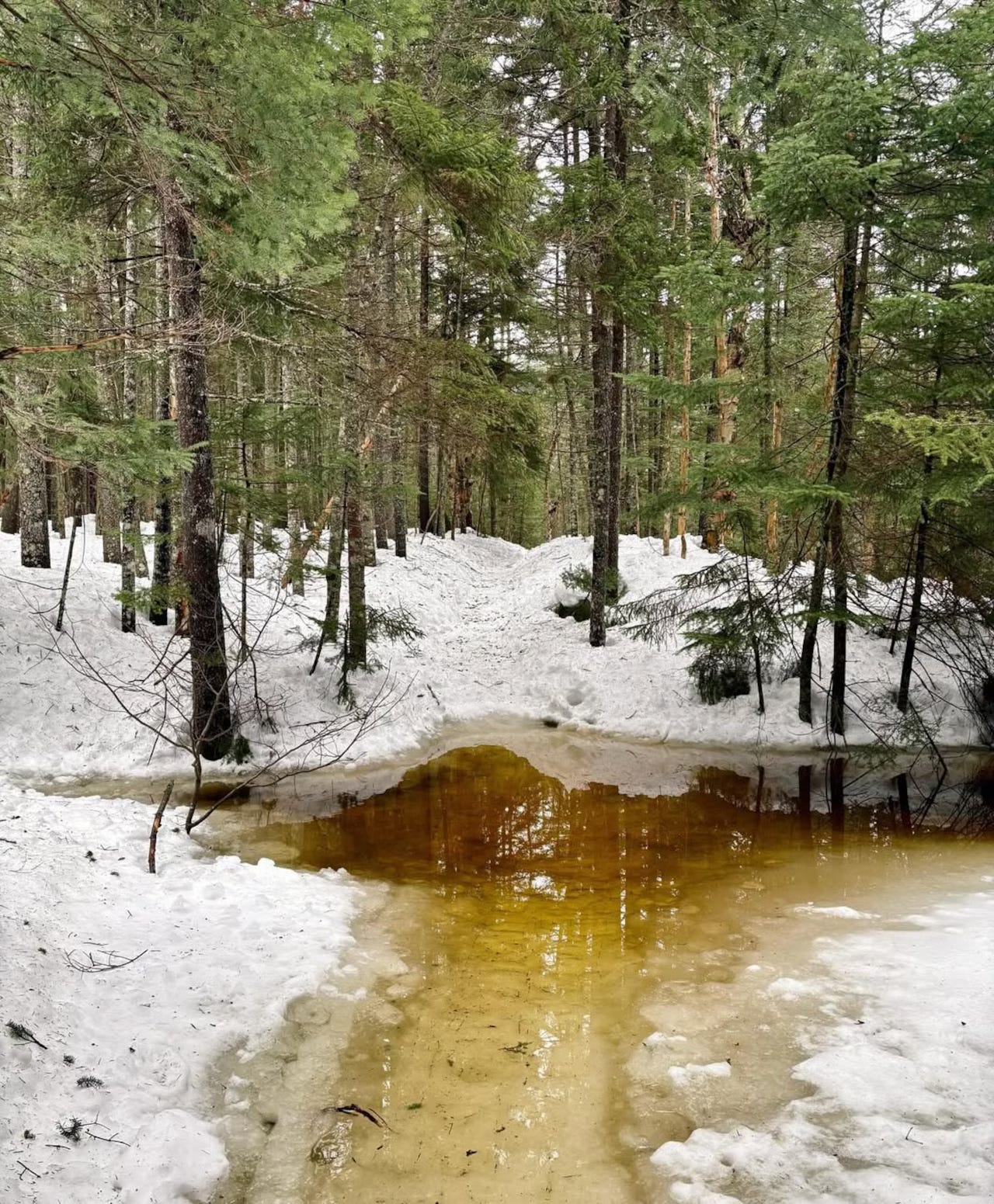
Even return can feel unsteady.
Spring comes slowly to the Adirondacks. Snow mounds melt unevenly; the ice in the driveway turns wet, then solid again. The sun is bright, but there are no signs yet of the lush greenery that will come, all at once, sometime from now. The ground gives way underfoot. Nothing is settled.
We call this renewal.
But it doesn’t feel gentle.
I’ve been traveling this month—to Tucson and New York City—and the return home reminds me that transitions are rarely smooth. Even a return home can feel disorienting. As if the place you’ve come back to has shifted slightly in your absence. Or perhaps you have.
Persephone spent each year moving between the underworld and Mount Olympus, her time divided between two realms that could never fully reconcile. We tend to tell her story as a cycle—descent, return, descent again—but it never feels that simple. Because the places she returns to cannot be exactly as she left them. And neither is she.
In some tellings—and in more recent imaginings—Persephone does not simply dwell in the underworld; she sits in judgment. She listens to the stories of the dead. She weighs what they’ve done, what they’ve failed to do, what they might have been. She carries those stories with her.
I imagine how that would change a person.
To listen, over and over, to the accounting of a life. To see where choices narrowed or opened, where harm was done or endured. Some of those stories might harden you. Others might deepen your compassion. Either way, they would mark you.
And then to return—to a world of light, of music, of ease. To a place untouched by consequence, where time stretches differently, and nothing is ever truly lost. That return would not be simple either. It would carry a kind of dissonance. A knowledge that does not translate.
We call her story a cycle. But it is really a story of change.
Because while Persephone moves between worlds, she is never the same goddess who left. Some part of her remains below, even when she walks again in the light.
Maybe that’s why her story lingers. It feels closer to our own lives than we often admit.
We imagine we can leave and come back unchanged. That movement is temporary, that return restores us to where we were. But it doesn’t work that way. Travel loosens things. Plans shift. We shift. What once felt stable reveals itself as provisional.
And change—even the kind we welcome—asks something of us.
I feel that now, more than usual. My daughter’s wedding approaches. My mother slips further into unknowing. There is travel ahead—Sardinia, Sicily—and the slow, uneven progress of a new novel, The Orphans’ Wheel. All of it unfolding against a wider sense of instability: war, displacement, the erosion of norms we once thought secure. The old logic—might makes right—asserting itself again.
It is disorienting.
There is hope, of course. There always is. But there is also grief—for what was, and for what will not be. Because even the best changes carry some loss. Something is left behind, whether we choose it or not.
Like Persephone, I sometimes feel as though I am living in two worlds at once—the past and a present I no longer fully recognize.
During this season—Passover, Easter—we are surrounded by images of rebirth and renewal. But those stories, too, begin in suffering. Before liberation, there is bondage. Before resurrection, there is death. Before anything new can emerge, something must be revealed—about power, about cruelty, about what has been hidden.
Spring does this as well.
It does not simply heal. It exposes. What has been buried comes into the light.
As I step into this season, I am reminded that there is no true return. The place I stand now is not the one I left at the start of winter. And I am not the same person who stood there then.
Like Persephone, I carry both worlds with me.
And what matters, finally, is not finding our way back, but learning how to stand where we are—changed, and still ourselves.
I had to wrack my brains for this quote (and then check the Internet). Attributed to Heraclitus: "No man ever steps in the same river twice, for it's not the same river and he's not the same man". We can perhaps update that to, "no person". :)
So true that we never pass the same way twice as the same person, but the process of change and renewal are not new just the changes they reveal. And while we wish we could change some of what is revealed to us we have to adapt and there we go changing again.
So I guess all of this to say we are always in a constant state of change - some good, some not so much. Wishing you loads of good change to come.