
The Objects That Help Me Write the Past
Burins, Madonnas and the Small Clues that Shape a Novel

One of the questions readers always seem to ask is: How do you do research?
Amidst my packing for the Tucson Literary Festival and preparing for podcasts and book events, I’ve been thinking about that question.
People sometimes imagine historical fiction turning on big events, like wars, revolutions, or famous leaders. But when I look back at my notebooks, the moments that have changed my novels have been much smaller.
For me, research for a novel set in the past rarely begins with a big event. It starts with a question about a person: what they wanted and what stood in their way. This is what distinguishes historical novels from archival or purely historical research. For example, the archives may reveal when someone emigrated to a new land, but not why; they may explain the deeds they accomplished in their lifetimes, but not what motivated them.
In my current work-in-progress, the protagonist is an idealistic noblewoman. She leaves her bastard child in the orphans’ wheel. This is irrefutable. But there is no context. It’s up to me to provide this and to write a story that stays true to her goals and desires.
Fictional characters aren’t as complicated as real people—they’re composites, fragments, simplified versions. The novelist has to distill a life into those central motives that make a story move.
So when I set out to write Rosina, I looked for ways to discover who she is. Archives, letters, household records, history books—these are often good starting places for historical research. But for many characters, especially women, these records are insufficient. They may be artists or counterfeiters, seamstresses or servants, nurses or cooks. But this work, like most of women’s work, is in the hidden economy. It sustains families and communities, but it rarely leaves a clear archival trace. It falls to the novelist to find some way to bring their characters to life.
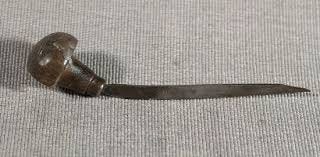
In Seeds of the Pomegranate, researching famous currency counterfeiters like Stella Frauto helped. I kept Stella in mind as I wrote Mimi, studying the pigment charts and learning about the portable printing presses used in the early 20th century. I also kept a burin on my desk to help me to understand what Mimi felt when she used that tool, and I taped a photo of a five-dollar bill to help me identify the technical challenges she might have faced in replicating it on a copper plate.
In my current WIP, I’m reading Enlightenment thinkers like Jean Jacques Rousseau, and studying the layout of convents in Western Sicily. I’ve got some talismans, too, like the olive wood rosary beads my elderly aunt gave me—property of my great-great-grandmother or some other distant, though unidentified, ancestor. Or the photograph of a 19th-century Madonna statue, identified as Our Lady of Sorrows.
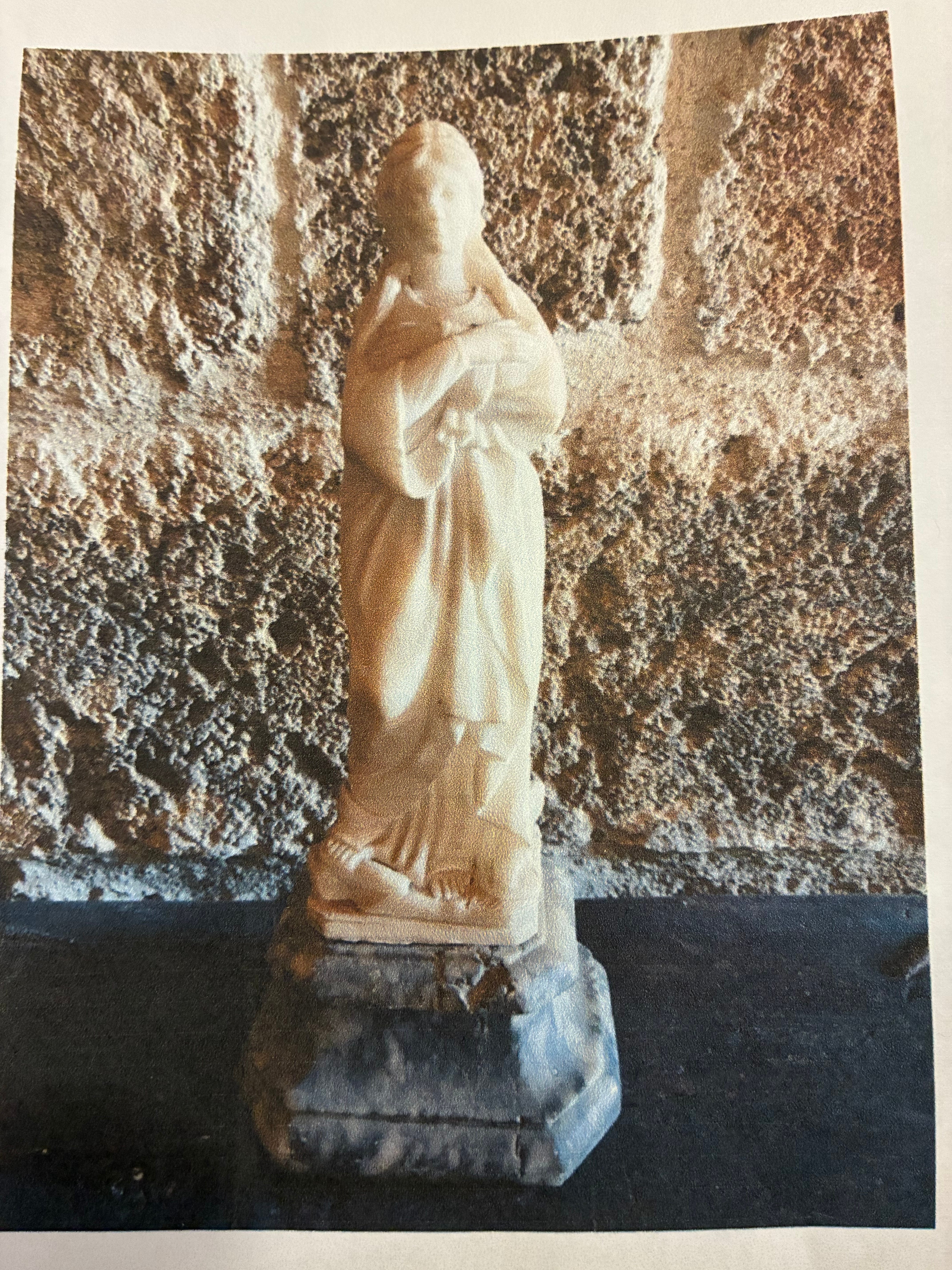
I’ve taped this photo of the Madonna above my writing desk, and when I’m trying to understand how Rosina is managing with the loss of her son, I think about how she might have drawn comfort from it—this Madonna, her arms empty, her gaze downcast. This grieving, childless mother might have provided comfort to Rosina as she yearned for her son.
These objects—the burins, color wheels, and statues of the Madonna—help me to understand who these women were. They help me live inside them: to feel, and touch, and experience the kinds of things they experienced. In this way, my research becomes less about collecting facts than about entering my protagonist’s emotional world. This feels key to writing a more fully dimensional character.
Much of writing is an intuitive process. I didn’t know this when I made the shift from academic writing to creative nonfiction and then fiction. Frankly, I didn’t trust myself to know what the story was, and worried that what I had to say was too obvious or outrageous to make into a story or essay. But over time, I’ve learned that the archives, the objects, and the questions I carry with me all eventually begin to speak to one another. I’ve learned to trust that stories are all around us, just waiting to be plucked from the air.
The key is to find something that thrills you or troubles you, and to write into that until you discover the thread of the story. Sometimes the thread begins with something small—a tool on a desk, or a faded image of a Madonna with empty arms—waiting for someone to glimpse the life behind it.
What small object or image has ever helped you glimpse a life behind it?
Great post. As I wrote my novel, I had a cut glass doorknob nearby, its post sticking out like some fundamental lack of connection laid bare. My protagonist steals it from the family home that her sister claims as her own. The object reminded me of doors being closed and, towards the end of the book, other doors opening. I would sit and hold it when I felt stuck in my writing.
This post really resonated for me. I have written two substacks about finding something small in my research that inspired me to write my novel Fission, based loosely on my parents' Manhattan Project stories. The first was a pristine program my mother kept all her adult life from a concert she played with an orchestra at age 16: https://leslierschoverphd147820.substack.com/p/nuclear-fiction-newsletter-issue-b99?r=btzfh The second was finding a brief anecdote in a book of interviews with my father's group leader about the day the bombing of Hiroshima was announced and my father providing a forbidden radio at the lab: https://leslierschoverphd147820.substack.com/p/nuclear-fiction-newsletter-issue-793?r=btzfh