
Sicily Notebook #1
Returning to Sicily in Search of Rosina Inglese

Six weeks in Sicily and Sardinia: archives, village streets, foundling histories, family records, and the making of The Orphans’ Wheel, a historical novel inspired by erased identities and hidden lives in western Sicily.
I’m writing this from Sardinia.
I’ve come here for a conference on Sicily, migration, identity, and the Italian diaspora. In a few days, I’ll travel onward to western Sicily itself: Palermo, Partanna, Castelvetrano, the roads between towns, the archives, the churches, and the landscapes that shaped both my family history and the novel I’m still trying to understand.
Over the next six weeks, I’ll be sharing a series of dispatches from this journey here on Substack: fragments from archives, village streets, train stations, libraries, cemeteries, conversations, family records, and the physical world behind The Orphans’ Wheel.
Because at the center of this journey is one woman:
Rosina Inglese.
A missing father in the 1910 census.
A grandmother with the same maiden name as her granddaughter.
A surname that marked my family as outsiders, even back in Sicily.
Those were the questions that first led me toward the story that became The Orphans’ Wheel.
My first trip to Sicily was meant to be a sightseeing trip. I traveled with my mother, son, and nephew. We saw Agrigento and Palermo, churches and mosaics, and the overwhelming beauty of the landscape.
But the questions followed me there.
When I mentioned my family history to a guide, she suggested a visit to the Town Hall in the mountain village my family came from—a place I had only seen on a map, perched above narrow streets and stone buildings.
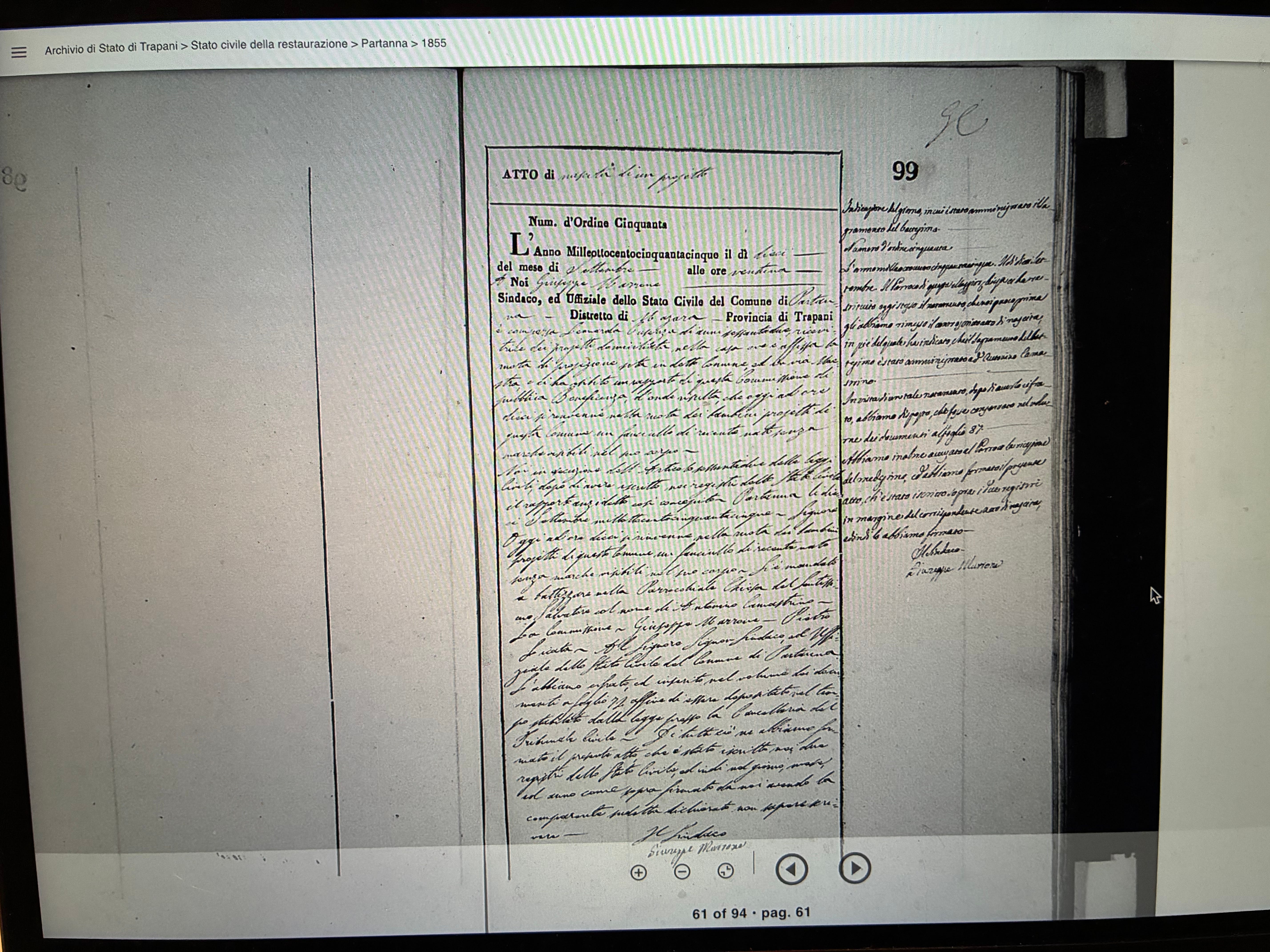
Inside, floor-to-ceiling bookcases held centuries of records.
The clerk traced a finger down the page of a birth register belonging to my great-great-grandfather.
“Here,” he said. “His birth name—Camastrino. It marks him as a child left in the wheel.”
Then another notation.
Crossed out.
Inglese written in its place.
The story shifted in that instant.
Not because the records explained everything. They didn’t.
But because they revealed how much had been hidden beneath the stories my family carried forward: secrecy, reinvention, distrust of outsiders, identities altered by necessity or shame or survival.
My grandfather inherited two stories at once—the one he was born into and the one he carried forward.
And behind him stood another figure: his grandmother, Rosina Inglese.
A woman who, according to family history and fragments of archival record, left a newborn in the foundling wheel, reclaimed him decades later, emigrated to New York in her seventies, and died in a suspicious tenement fire at ninety.
The daughter of a noble family.
Or perhaps not exactly.
Already the facts blur at the edges.
That uncertainty is part of what drew me toward fiction.
Over the years, Rosina became more than an ancestor. She became the emotional center of The Orphans’ Wheel—a woman caught between privilege and precarity, between Sicily’s collapsing old order and the brutal realities facing women with too few choices.
But fiction requires more than documents.
To write her fully, I have to understand something of the world she inhabited:
the distances between towns,
the dry summer heat,
the scale of the hills,
the scent of wild fennel and rosemary,
the silence inside churches,
the long roads between Partanna and Palermo.
I want to understand what it meant to leave.
What it meant to stay.
And what it meant for women like Rosina to make impossible decisions inside systems that left so little room for freedom.
I don’t expect Sicily to provide simple answers.
One of the hardest lessons of writing historical fiction is accepting how much remains unknowable. It is through those gaps that we imagine how people lived, what they feared, and why they made the choices they did.
Who was Rosina Inglese?
The question began in the archives.
Now it has brought me back to Sicily.
And we'll get to smell the scents, feel the heat of day and explore the sights with you. What magic.
Love it! I feel like we’ll be taking this journey with you. Enjoy!